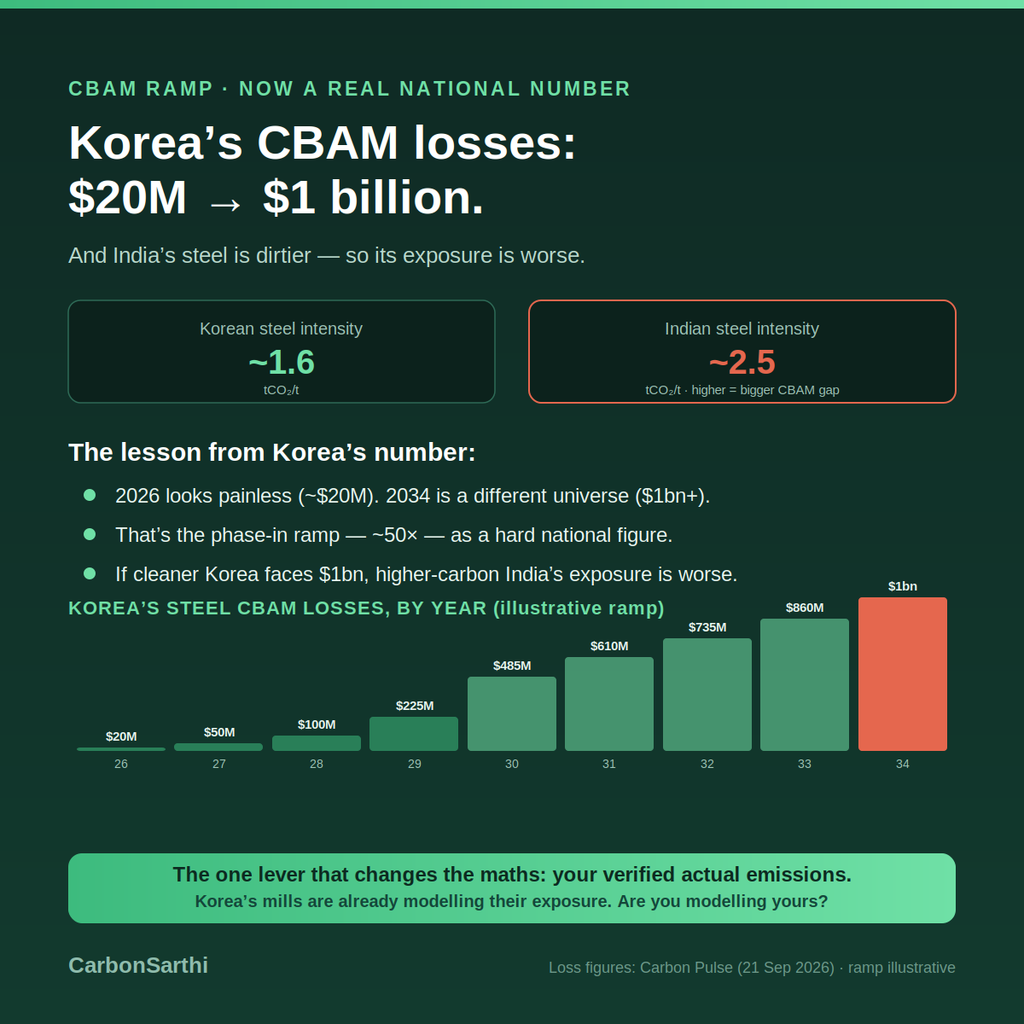
A single number published this week should stop every Indian steel exporter in their tracks. According to carbon-market intelligence service Carbon Pulse, South Korea’s steel sector is facing EU Carbon Border Adjustment Mechanism (CBAM) related trade losses that rise from around $20 million in 2026 to over $1 billion by 2034, as the mechanism fully phases in.
That is roughly a fifty-fold increase over eight years — and it is the clearest illustration yet of a warning we have been making for months: the small CBAM bill you see in 2026 is not the CBAM bill you will pay. It is the first step of a very steep staircase.
For Indian exporters, the story carries an extra sting. Korea’s steel is cleaner than India’s. If a lower-carbon producer is staring at a billion-dollar hit, the exposure for higher-carbon Indian steel — tonne for tonne — is proportionally worse.
Let’s break down what this number actually tells you, and what to do about it.
The number that makes the CBAM ramp real
Most exporters have heard that CBAM “phases in gradually.” Few have internalised what that phrase actually means for their costs. Korea’s projection turns the abstract into the concrete.
CBAM’s cost in any given year is governed by a phase-in factor — the percentage of the full carbon cost that is actually payable. That factor climbs year by year, from just 2.5% in 2026 to 100% by 2034. It is fixed in the regulation, and it is the one genuinely certain input in the whole system.
The shape of that climb is what matters. The early years are gentle. The later years are brutal. Korea’s numbers map onto this exactly: a near-negligible ~$20 million exposure in 2026 becomes a ~$1 billion problem by 2034. Nothing about Korea’s steel industry needs to change for this to happen — the increase comes almost entirely from the phase-in factor ratcheting upward toward full force.
This is the trap that catches unprepared exporters. A business looks at its tiny 2026 CBAM cost, concludes “this is manageable, we’ll deal with it later,” and files it away. But 2026 is the smallest CBAM will ever be. Every year the cost multiplies, and by the time it becomes impossible to ignore, the competitors who prepared early have already locked in their advantage.
Why India’s exposure is worse than Korea’s
Here is the part that should make Indian exporters pay more attention to Korea’s number, not less.
CBAM charges on the carbon embedded in each tonne of product. The higher your steel’s carbon intensity, the larger your CBAM liability — and, critically, the larger the gap between your emissions and the EU’s default values, which are the punitive fallback numbers applied when you cannot prove your actual figure.
Korean steel is relatively low-carbon. Indian steel is not. India’s steel sector is among the most carbon-intensive of any major producer — averaging roughly 2.5 tonnes of CO₂ per tonne of steel, against a Korean figure materially lower and a global average nearer 1.9. The reason is structural: so much Indian steelmaking is coal-based, through the blast-furnace and coal-DRI routes.
Put those two facts together and the conclusion is uncomfortable but unavoidable. India’s steel faces the same CBAM ramp as Korea’s — but from a higher starting intensity. More carbon per tonne means a bigger bill per tonne, and a wider gap to the default values the EU imposes on undocumented producers. If cleaner Korea is modelling a billion-dollar exposure, the proportional threat to India’s higher-carbon steel is greater still.
This is not a reason for despair. It is a reason for precision.
The one lever that changes the maths
There is exactly one thing an exporter controls that changes this equation, and it is the same lever every time: your verified actual emissions.
CBAM does not charge you on your country’s average. It does not care that India’s per-capita emissions are low, or that India leads on renewables. When your steel crosses the EU border, the mechanism asks one question: how much carbon is embedded in this specific tonne — and can you prove it?
If you cannot prove it, you are assigned the default value — deliberately set high, on the assumption that a producer who will not share data is among the dirtiest. If you can prove it, your buyer pays on your real number. And for an efficient producer — particularly one using scrap-based or electric-arc routes rather than coal-heavy blast furnaces — that real number is often far below both the Indian national average and the punitive default.
That gap is the entire commercial opportunity in CBAM. It is the difference between being the expensive supplier your European buyer quietly replaces, and being the documented, verified supplier they keep. The national average does not protect your margin. Your plant’s proven number does.
What Indian steel exporters should do now
Korea’s steelmakers are not waiting until 2034 to act — they are modelling their exposure today and preparing accordingly. Indian exporters shipping to the EU should be doing the same. Practically, that means:
Know whether CBAM even applies to you. Not every steel product is covered, and not every exporter ships to the EU. Confirm your product’s exact CN code and your EU destinations before assuming anything — a surprising number of firms are wholly or partly outside CBAM’s scope.
Model your own ramp. Take your EU-bound volumes and your product’s emissions, and project the cost across the phase-in years to 2034. Seeing your own version of Korea’s $20M-to-$1bn curve is the fastest way to understand why early action matters.
Establish your actual emissions. For most producers, the data you need already exists — in fuel bills, electricity records, and production tonnages. The task is organising it to the EU’s methodology so it can be verified and used instead of the punitive default.
Prepare for verification. From 2027, actual emissions data generally needs sign-off from an accredited verifier to be used at the border. Verifier capacity is expected to be tight relative to demand, so planning early is wise.
Talk to your EU buyers. Understand exactly what they need and by when. Being the supplier who raises CBAM readiness proactively — rather than waiting to be asked — is itself a competitive signal.
The bottom line
Korea’s billion-dollar projection is not a distant forecast. It is a line item a major steel exporter is already putting in its accounts. The CBAM ramp has stopped being theoretical and started being budgeted.
For India — with steel that carries more embedded carbon per tonne — the exposure is, if anything, greater. But so is the opportunity: the wider the gap between the punitive default and your real emissions, the more you have to gain by proving your actual number.
The exporters who treat this as a reason to get their emissions data in order will turn a looming cost into a competitive advantage. The ones who read their small 2026 bill and look away will find the same steep staircase waiting — except their competitors will have spent the intervening years climbing it.
The ramp is real. The only question is whether you are modelling yours.