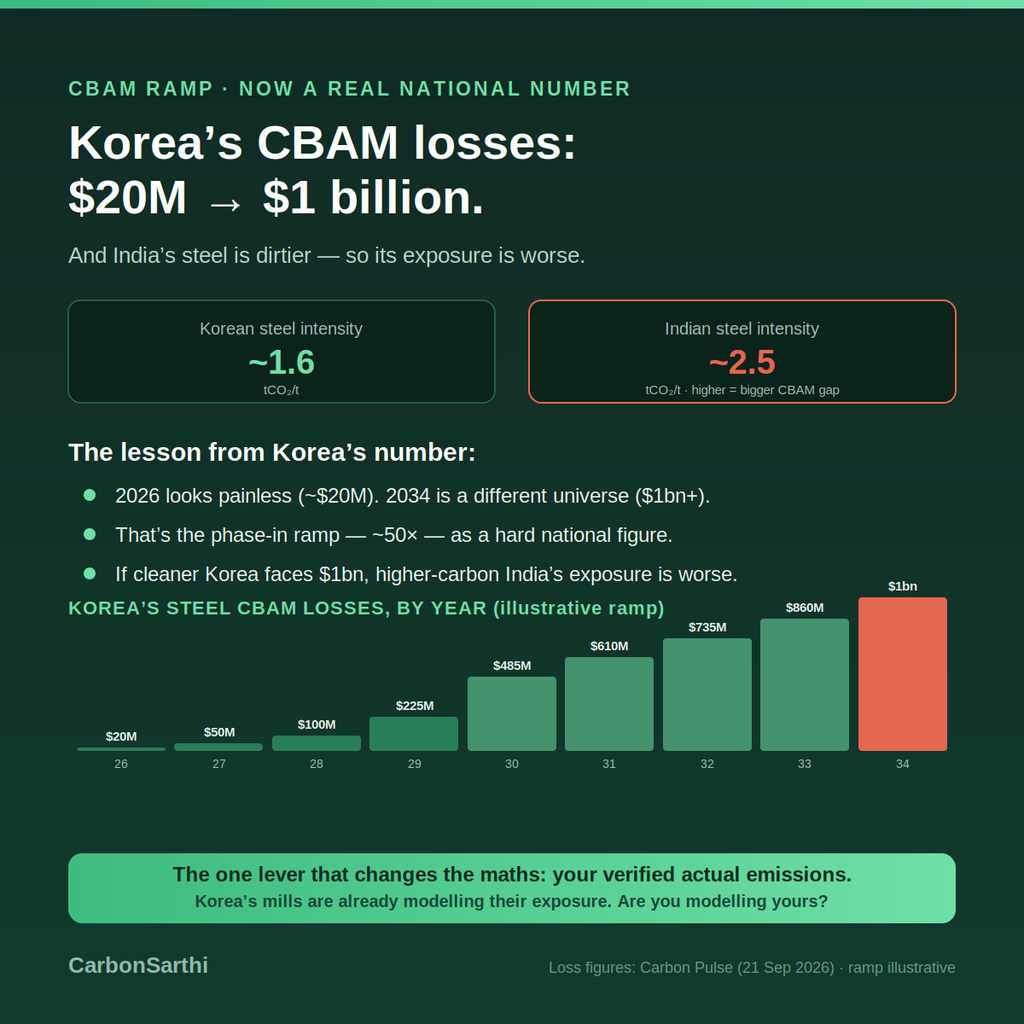
A single number published this week should stop every Indian steel exporter in their tracks. According to carbon-market intelligence service Carbon Pulse, South Korea’s steel sector is facing EU Carbon Border Adjustment Mechanism (CBAM) related trade losses that rise from around $20 million in 2026 to over $1 billion by 2034, as the mechanism fully phases in.
That is roughly a fifty-fold increase over eight years — and it is the clearest illustration yet of a warning we have been making for months: the small CBAM bill you see in 2026 is not the CBAM bill you will pay. It is the first step of a very steep staircase.
For Indian exporters, the story carries an extra sting. Korea’s steel is cleaner than India’s. If a lower-carbon producer is staring at a billion-dollar hit, the exposure for higher-carbon Indian steel — tonne for tonne — is proportionally worse.
Let’s break down what this number actually tells you, and what to do about it.
The number that makes the CBAM ramp real
Most exporters have heard that CBAM “phases in gradually.” Few have internalised what that phrase actually means for their costs. Korea’s projection turns the abstract into the concrete.
CBAM’s cost in any given year is governed by a phase-in factor — the percentage of the full carbon cost that is actually payable. That factor climbs year by year, from just 2.5% in 2026 to 100% by 2034. It is fixed in the regulation, and it is the one genuinely certain input in the whole system.
The shape of that climb is what matters. The early years are gentle. The later years are brutal. Korea’s numbers map onto this exactly: a near-negligible ~$20 million exposure in 2026 becomes a ~$1 billion problem by 2034. Nothing about Korea’s steel industry needs to change for this to happen — the increase comes almost entirely from the phase-in factor ratcheting upward toward full force.
This is the trap that catches unprepared exporters. A business looks at its tiny 2026 CBAM cost, concludes “this is manageable, we’ll deal with it later,” and files it away. But 2026 is the smallest CBAM will ever be. Every year the cost multiplies, and by the time it becomes impossible to ignore, the competitors who prepared early have already locked in their advantage.
Why India’s exposure is worse than Korea’s
Here is the part that should make Indian exporters pay more attention to Korea’s number, not less.
CBAM charges on the carbon embedded in each tonne of product. The higher your steel’s carbon intensity, the larger your CBAM liability — and, critically, the larger the gap between your emissions and the EU’s default values, which are the punitive fallback numbers applied when you cannot prove your actual figure.
Korean steel is relatively low-carbon. Indian steel is not. India’s steel sector is among the most carbon-intensive of any major producer — averaging roughly 2.5 tonnes of CO₂ per tonne of steel, against a Korean figure materially lower and a global average nearer 1.9. The reason is structural: so much Indian steelmaking is coal-based, through the blast-furnace and coal-DRI routes.
Put those two facts together and the conclusion is uncomfortable but unavoidable. India’s steel faces the same CBAM ramp as Korea’s — but from a higher starting intensity. More carbon per tonne means a bigger bill per tonne, and a wider gap to the default values the EU imposes on undocumented producers. If cleaner Korea is modelling a billion-dollar exposure, the proportional threat to India’s higher-carbon steel is greater still.
This is not a reason for despair. It is a reason for precision.
The one lever that changes the maths
There is exactly one thing an exporter controls that changes this equation, and it is the same lever every time: your verified actual emissions.
CBAM does not charge you on your country’s average. It does not care that India’s per-capita emissions are low, or that India leads on renewables. When your steel crosses the EU border, the mechanism asks one question: how much carbon is embedded in this specific tonne — and can you prove it?
If you cannot prove it, you are assigned the default value — deliberately set high, on the assumption that a producer who will not share data is among the dirtiest. If you can prove it, your buyer pays on your real number. And for an efficient producer — particularly one using scrap-based or electric-arc routes rather than coal-heavy blast furnaces — that real number is often far below both the Indian national average and the punitive default.
That gap is the entire commercial opportunity in CBAM. It is the difference between being the expensive supplier your European buyer quietly replaces, and being the documented, verified supplier they keep. The national average does not protect your margin. Your plant’s proven number does.
What Indian steel exporters should do now
Korea’s steelmakers are not waiting until 2034 to act — they are modelling their exposure today and preparing accordingly. Indian exporters shipping to the EU should be doing the same. Practically, that means:
Know whether CBAM even applies to you. Not every steel product is covered, and not every exporter ships to the EU. Confirm your product’s exact CN code and your EU destinations before assuming anything — a surprising number of firms are wholly or partly outside CBAM’s scope.
Model your own ramp. Take your EU-bound volumes and your product’s emissions, and project the cost across the phase-in years to 2034. Seeing your own version of Korea’s $20M-to-$1bn curve is the fastest way to understand why early action matters.
Establish your actual emissions. For most producers, the data you need already exists — in fuel bills, electricity records, and production tonnages. The task is organising it to the EU’s methodology so it can be verified and used instead of the punitive default.
Prepare for verification. From 2027, actual emissions data generally needs sign-off from an accredited verifier to be used at the border. Verifier capacity is expected to be tight relative to demand, so planning early is wise.
Talk to your EU buyers. Understand exactly what they need and by when. Being the supplier who raises CBAM readiness proactively — rather than waiting to be asked — is itself a competitive signal.
The bottom line
Korea’s billion-dollar projection is not a distant forecast. It is a line item a major steel exporter is already putting in its accounts. The CBAM ramp has stopped being theoretical and started being budgeted.
For India — with steel that carries more embedded carbon per tonne — the exposure is, if anything, greater. But so is the opportunity: the wider the gap between the punitive default and your real emissions, the more you have to gain by proving your actual number.
The exporters who treat this as a reason to get their emissions data in order will turn a looming cost into a competitive advantage. The ones who read their small 2026 bill and look away will find the same steep staircase waiting — except their competitors will have spent the intervening years climbing it.
The ramp is real. The only question is whether you are modelling yours.
A great deal of CBAM confusion comes from one basic uncertainty: who actually files the report, and what goes into it? Exporters often worry they must submit something to the EU themselves. The reality is more nuanced, and understanding it clearly tells you exactly where your responsibility begins and ends. This guide breaks down who files, what the report contains, and the crucial role you play as an exporter.
Who is legally responsible for filing?
The legal duty to file the CBAM report sits with the EU importer – the company bringing your goods into Europe. In the definitive phase, that importer must hold “authorised CBAM declarant” status and submit an annual CBAM declaration to the EU authorities. As an Indian exporter, you do not file this declaration and you do not submit anything directly to the EU.
But here is the catch that makes CBAM very much your concern: the importer cannot complete that declaration without emissions data from you. Your figures are the raw material of their report. So while the filing is not your legal obligation, being the source of the data places you at the centre of the process.
What a CBAM declaration contains
A CBAM annual declaration broadly pulls together the following information:
- The type and quantity of covered goods imported during the year, identified by their CN codes.
- The embedded emissions of those goods, expressed in tonnes of carbon dioxide.
- Whether those emissions are based on actual measured data or on EU default values.
- Any carbon price already paid in the country of origin, which can reduce the amount owed.
- Verification details confirming the emissions data has been independently checked by an accredited verifier.
- The number of CBAM certificates to be surrendered to cover the emissions.
Your role: the emissions data package
In practice, the single most valuable thing you can provide your EU buyer is a clean, well-organised, verified emissions data package for your product. A strong package shows your emissions per tonne, explains clearly how you measured them, identifies your direct and indirect sources, and comes with verification from an approved body.
Think about it from the buyer’s side. A supplier who hands over a clear, verified package makes the importer’s job easy and their compliance safe. A supplier who provides nothing forces the importer to fall back on EU default values – which are usually higher and therefore more expensive. Being the easy, low-cost supplier is a genuine commercial advantage, and it starts with the quality of the data you provide.
Actual data vs. default values in the report
The declaration must state whether emissions are based on your actual data or on defaults. This choice has real financial weight. If your verified actual emissions are lower than the default – as they often are for efficient producers – using them reduces the certificates the importer must buy. If you provide nothing, the importer uses the higher default, and your product effectively costs them more. This is why the data package you supply is not a formality; it directly shapes the numbers in the report and the cost attached to your goods.
The timeline behind the report
Timing trips up many exporters. The first annual CBAM declaration, covering 2026 imports, is due by 30 September 2027. That sounds comfortably far off, but the emissions data behind it must be collected throughout 2026 and then verified – a process that itself takes time. Waiting until 2027 to start gathering numbers is a recipe for a scramble, rushed data, and stressed buyers. The smart exporters treat their buyer’s September deadline as a finish line they cross months early.
A practical checklist for exporters
- Collect fuel, electricity and production data continuously, not at year-end.
- Organise supporting documents – invoices, meter readings, logs – clearly and by date.
- Arrange independent verification well before your buyer’s deadline.
- Package the verified figures with a clear explanation of your method.
- Send the package to your buyer early, and confirm it contains everything they need.
What happens if you provide nothing
It is worth spelling out the consequence of inaction, because it is easy to underestimate. If you send your buyer no emissions data, they do not simply give up – they fall back on EU default values, which are set high by design. Your product’s reported footprint jumps to that pessimistic estimate, and the carbon cost attached to your goods rises accordingly. The buyer, now facing a higher cost on your product than on a competitor’s better-documented one, has every reason to renegotiate your price or shift the order elsewhere.
So “doing nothing” is not a neutral choice. It actively pushes your product toward the most expensive possible treatment under CBAM. Providing data is not just about being helpful; it is about defending the price and competitiveness of your own goods.
There is a relationship dimension too. Buyers talk to each other, and reputations travel. An exporter known for delivering clean, verified data on time becomes the kind of supplier importers actively recommend and return to, because working with you lowers their compliance risk. Over several years, that reputation can matter as much as price – it is the difference between being a supplier buyers tolerate and one they seek out.
Frequently asked questions
Do Indian exporters file the CBAM report themselves?
No. The EU importer files the annual CBAM declaration. However, exporters must supply the emissions data the importer needs to complete it.
What information does a CBAM declaration include?
It includes the quantity of covered goods, their embedded emissions, whether actual or default data was used, any carbon price paid at origin, verification details, and the certificates to be surrendered.
When is the first CBAM declaration due?
The first annual declaration, covering 2026 imports, is due by 30 September 2027, with subsequent declarations due each 30 September.
The bottom line
The EU importer files the CBAM report, but you supply the fuel that makes it work. Being the exporter who delivers a clean, verified, on-time emissions data package is the simplest way to keep the cost on your goods low and to remain a preferred, low-risk supplier in the European market.
The entire CBAM system rests on a single number: the emissions embedded in your product. The cost, the paperwork, the negotiations with buyers – everything flows from that one figure. So if you understand how it is calculated, you understand the heart of CBAM. This guide walks through the calculation step by step, in plain language, with a worked example, so you can see exactly where your numbers come from and where you can influence them.
What “embedded emissions” really means
Embedded emissions are all the carbon dioxide released in the process of making your product. They fall into two main groups. Direct emissions come from fuel you burn on-site – the coal, gas or oil feeding your furnaces, boilers and kilns. Indirect emissions come from the electricity you buy from the grid; you do not burn the fuel yourself, but a power station does on your behalf, so those emissions still belong to your product.
For some products, a third element matters: the emissions embedded in precursors – the input materials you bought to make your product. If you produce fasteners from purchased steel, the carbon in that steel forms part of your fastener’s footprint. The calculation, then, is about capturing the full carbon story of your product, not just what happens inside your own four walls.
Step 1: Identify and measure your emission sources
The first step is to add up how much fuel and electricity your facility uses over a defined period – usually a year. You gather this from fuel purchase invoices, consumption logs and electricity bills. If your plant makes intermediate materials that feed into the final product, those are counted too. The goal is a complete, honest picture of energy going into production.
Step 2: Convert energy use into carbon
Raw fuel and electricity figures are not emissions yet. To convert them, you multiply each by a standard emission factor – a number that tells you how much carbon dioxide each unit of fuel or electricity produces. Burn a tonne of a particular fuel, and the factor tells you the carbon released. Use a unit of grid electricity, and a grid emission factor tells you the associated carbon. Add these up and you have your total emissions for the period.
Step 3: Divide by how much you produced
Next, you divide total emissions by the amount of product made in the same period. This gives emissions per tonne of product – the key intensity figure CBAM cares about. For example, if your plant released 20,000 tonnes of carbon dioxide while making 10,000 tonnes of steel, your embedded emissions are 2 tonnes of carbon per tonne of steel.
Step 4: Multiply by the quantity exported
Finally, that per-tonne figure is multiplied by the quantity actually shipped to the EU. If you export 500 tonnes of that steel, the embedded emissions attached to the shipment are 500 multiplied by 2, which is 1,000 tonnes of carbon dioxide. This is the number your EU importer reports and, from 2027, pays for through CBAM certificates.
A full worked example
Let us put it together. Suppose your plant used fuel and electricity that, once converted, produced 24,000 tonnes of carbon dioxide in a year, and you made 12,000 tonnes of aluminium products. Your intensity is 24,000 divided by 12,000, which is 2 tonnes of carbon per tonne of product. If a European buyer orders 300 tonnes, the embedded emissions on that order are 600 tonnes of carbon dioxide. If the effective carbon price were, say, 70 euros per tonne, the rough CBAM cost on that shipment would be around 42,000 euros. Now imagine you cut your intensity to 1.6 through efficiency and cleaner power: the same order carries 480 tonnes of carbon and roughly 33,600 euros – a saving of over 8,000 euros on a single shipment, purely from a lower footprint.
Why cleaner production directly saves money
That example reveals the most important point. Because the cost is tied to emissions per tonne, every improvement in your process – more efficient furnaces, better fuel, cleaner electricity, less waste – lowers the number and therefore lowers the CBAM cost your buyer faces. The calculation is not just an accounting chore; it is effectively a map showing where reducing emissions turns directly into a price advantage. For Indian producers, where grid electricity is often the biggest contributor, sourcing renewable power can be one of the most powerful levers of all.
Direct vs. indirect: which counts?
A practical question exporters ask is whether they must count grid electricity (indirect emissions) or only their own fuel (direct emissions). The answer depends on the product and the specific rules for that sector. For several covered goods, indirect emissions do count – which is exactly why electricity-heavy products like aluminium are so exposed. The safe approach is to measure both your direct and indirect emissions, so you have the full picture regardless of how the rules apply to your product.
Frequently asked questions
What are embedded emissions in CBAM?
They are the total carbon dioxide released while producing a good, including direct emissions from on-site fuel, indirect emissions from purchased electricity, and often the emissions in input materials (precursors).
How is the CBAM emissions figure for a shipment calculated?
You calculate emissions per tonne of product (total emissions divided by output), then multiply by the quantity exported. That gives the embedded emissions attached to the shipment.
Does grid electricity count toward CBAM emissions?
For several covered products, yes – indirect emissions from purchased electricity are included. This is why products made with coal-based power tend to have higher CBAM costs.
The bottom line
CBAM calculation comes down to a clear logic: measure your carbon, convert it with emission factors, divide by output, and multiply by what you export. Master this and you not only understand CBAM – you can see exactly where reducing emissions turns into money saved and orders protected.